
A single Burmese ruby the size of a pigeon egg once sold for over $30 million. That’s what happens when a stone spends centuries being called “the king of gems” — people start fighting over it.
If you’re born in July, that stone belongs to you. The july birthstone meaning goes way deeper than “it’s red and it’s pretty.” Ruby has been tied to royalty, war, love, and protection for thousands of years, and it’s still one of the most requested gemstones on the planet.
Here’s everything you actually need to know: what july birthstone is, why it’s ruby, what the color and symbolism really mean, where the good ones come from, how to avoid buying a fake, and what your zodiac chart has to say about it.
What Is July’s Birthstone?
The july birthstone is ruby — a deep red variety of the mineral corundum. It’s been the official birthstone for July since the modern birthstone list was standardized in 1912 by the National Association of Jewelers (now Jewelers of America), but ruby had already been linked to July for centuries before that in various traditional lists.
July’s birthstone is ruby, a red gem variety of corundum known for its deep color, extreme hardness, and long history as a symbol of passion, protection, and power. It has held this position on official birthstone lists since at least the early 1900s.
July Birthstone Color
Ruby’s color ranges from bright pinkish-red to a deep, almost blackish-red called “pigeon’s blood” — the most prized shade in the industry. That color comes from trace amounts of chromium trapped inside the crystal structure. More chromium generally means a more vivid red, but too much can push the stone toward a brownish tone instead.
- Pigeon’s blood red — the top-tier, most valuable shade
- Pinkish-red — common, especially in stones from Sri Lanka
- Purplish-red — often seen in Thai and Cambodian rubies
- Brownish-red — lower value, muddier color
July birthstone color is red, ranging from vivid pinkish-red to deep blood-red. The most valuable shade, called “pigeon’s blood,” is a rich, slightly purplish red with strong saturation and minimal brown or gray tones.
Ruby Meaning and History
Ruby’s name comes from the Latin word ruber, meaning red. Ancient Sanskrit texts called it ratnaraj — “king of gems” — and that reputation stuck for a reason.
In medieval Europe, warriors believed wearing ruby made them invincible in battle. Burmese soldiers reportedly embedded rubies into their skin, believing it would make them bulletproof. Hindu tradition connected ruby to the sun and considered it one of the most powerful protective stones a person could own. Ancient Chinese burial customs sometimes involved ruby dust to preserve status and dignity in the afterlife.
By the Middle Ages, European royalty was obsessed with it — ruby appeared in crowns, ceremonial swords, and religious artifacts because it was associated with wealth, power, and divine favor. That reputation for royalty and status hasn’t really faded. Ruby is still one of the most common choices for engagement rings among people who want something bolder than a diamond.
Ruby’s meaning traces back thousands of years to ancient India, Burma, and medieval Europe, where it symbolized power, protection, and royalty. Warriors wore it for courage in battle, and royals used it as a symbol of status and divine favor.
Ruby Symbolism and Spiritual Meaning
Strip away the history and ruby’s core symbolism comes down to a handful of consistent themes across cultures:
- Passion and love — its deep red has always been linked to romantic love and desire
- Courage — historically worn by soldiers and leaders heading into conflict
- Protection — believed to guard the wearer from harm or negative energy
- Vitality — associated with strong life force, energy, and good health
- Wealth and success — tied to prosperity and status across multiple cultures
Ruby symbolizes passion, courage, protection, and vitality. Its deep red color has connected it to love and life force across cultures for centuries, and it’s traditionally believed to bring energy, confidence, and good fortune to whoever wears it.
Where Do Rubies Come From?
The best rubies in the world historically come from Myanmar (Burma), specifically the Mogok Valley — a region so famous for ruby mining it’s sometimes called the “Valley of Rubies.” Mogok stones tend to have that prized pigeon’s blood color.
Other major sources include:
- Mozambique — now one of the largest modern suppliers, producing high-quality stones
- Sri Lanka — known for lighter pinkish-red rubies
- Thailand — historically important, though mining has slowed significantly
- Madagascar — a newer but increasingly important source
Rubies primarily come from Myanmar’s Mogok Valley, historically the source of the finest “pigeon’s blood” stones. Mozambique, Sri Lanka, Thailand, and Madagascar are other major ruby-producing regions supplying today’s global jewelry market.
Does July Have Two Birthstones?
This is one of the most common questions people search — and the answer depends on which list you’re using. On the modern, official birthstone list, July has just one birthstone: ruby. But older traditional lists (some dating back centuries, before the 1912 standardization) occasionally paired July with onyx or, in a few regional lists, sardonyx.
If you’re shopping today, ruby is the answer almost everyone will give you. The “two birthstones” confusion usually comes from people mixing up modern and historical/traditional charts, or confusing July with months that genuinely do have two official stones, like October (opal and tourmaline) or December (turquoise, zircon, and tanzanite).
On the modern official birthstone list, July has only one birthstone: ruby. Some older traditional lists paired July with onyx instead, which is why people sometimes ask about a “second” July birthstone — but ruby is the widely accepted standard today.
Ruby Hardness and Durability
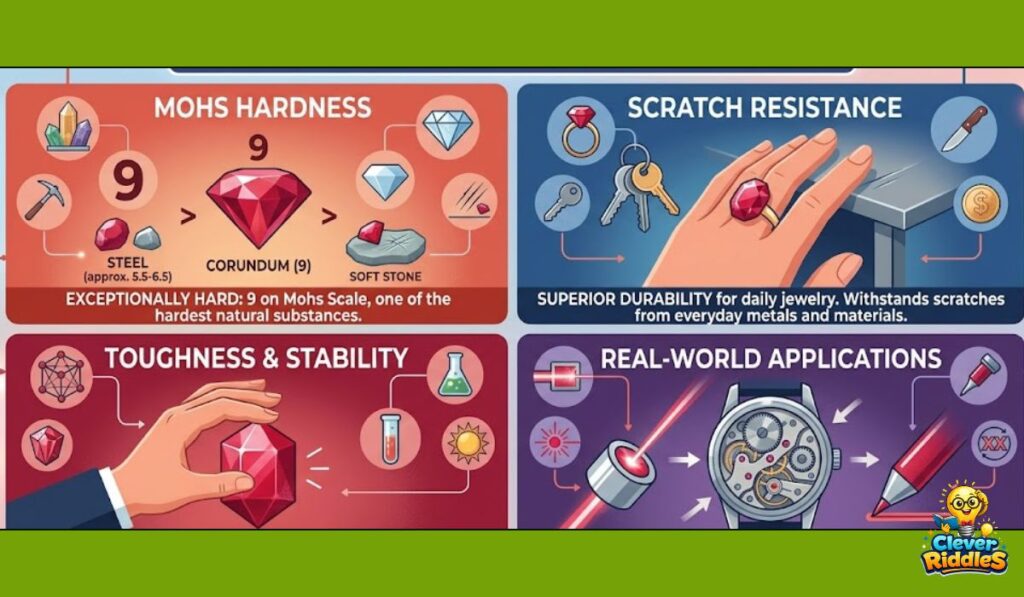
Ruby is a variety of corundum, which sits at 9 on the Mohs Hardness Scale — second only to diamond (10). That makes it one of the toughest gemstones you can wear daily without worrying much about scratches.
| Gemstone | Mohs Hardness | Everyday Wear Suitability |
| Diamond | 10 | Excellent |
| Ruby (Corundum) | 9 | Excellent |
| Sapphire (Corundum) | 9 | Excellent |
| Emerald | 7.5–8 | Good, needs care |
| Opal | 5.5–6.5 | Fragile, avoid daily wear |
Ruby scores a 9 on the Mohs Hardness Scale, making it the second-hardest natural gemstone after diamond. This durability is why ruby works well in rings and other jewelry worn every day without excessive risk of scratching or chipping.
Natural vs. Synthetic vs. Lab-Grown Ruby: What’s the Difference?
This trips a lot of buyers up, and it matters for both price and meaning.
A natural ruby formed underground over millions of years with zero human involvement — these are the most expensive and most sought-after. A synthetic ruby (often called lab-created) has the exact same chemical structure as a natural one but is grown in a lab in weeks instead of millennia, at a fraction of the price. A genuine ruby simply means it’s real corundum with chromium coloring — it can technically be either natural or synthetic, so that term alone doesn’t guarantee it came from the ground.
If someone tells you a ruby is “genuine” but won’t say natural or lab-grown, ask directly. It’s a completely fair question and any reputable jeweler will answer it without hesitation.
Natural rubies form underground over millions of years and are the most valuable. Synthetic (lab-grown) rubies share the same chemical makeup but are created in weeks at a much lower cost. “Genuine” only confirms it’s real corundum, not its origin.
How to Choose a Real, Quality Ruby
Buying ruby jewelry comes down to the same basic framework jewelers use for most colored gemstones:
Color — This is the single biggest value driver for ruby. Look for vivid, saturated red with minimal brown or purple undertone.
Clarity — Rubies almost always have some natural inclusions (tiny internal marks). Slight inclusions are normal and don’t hurt value much; heavy cloudiness does.
Cut — A good cut maximizes color and brilliance. Oval and cushion cuts are the most popular for ruby because they showcase color well.
Carat — Ruby gets exponentially more expensive per carat as size increases, more so than most gemstones, because large fine-quality rubies are genuinely rare.
Budget — Decide your ceiling before you shop. A vivid 1-carat ruby can cost more than a much larger diamond, so set expectations early.
Setting — Because ruby is so durable, it works in almost any setting style, from simple prong settings to more protective bezel designs.
What Wearing Ruby Actually Signals (The Psychology Nobody Talks About)
Here’s something most birthstone articles skip completely: the color you choose to wear sends a message before you say a single word, and ruby’s message is a specific one.
Red is the most attention-commanding color in human color psychology — it’s linked to confidence, urgency, and dominance in study after study on color perception. Someone wearing a ruby isn’t making a quiet choice the way someone wearing a pale aquamarine or soft moonstone is. They’re choosing a color that reads as bold, decisive, and a little unapologetic.
That’s part of why ruby has become such a popular alternative for engagement rings among people who want something that says “this relationship is intense” rather than “this relationship is safe.” It’s also why ruby shows up so often in power dressing — red carpet jewelry, statement cocktail rings, pieces meant to be noticed rather than blend in.
If you’re picking july birthstone jewelry for yourself, that’s worth thinking about. A ruby pendant worn to a job interview reads differently than the same pendant worn on a date. The gem doesn’t change — the context does.
July Birthstone Jewelry: Rings, Necklaces, and Bracelets
Ruby works across basically every jewelry category:
- Rings — Most popular for engagement rings and statement cocktail rings
- Necklaces and pendants — A single ruby solitaire pendant is a classic, understated option
- Earrings — Ruby studs are a common everyday choice since they’re durable enough for daily wear
- Bracelets — Often paired with diamonds in tennis bracelet styles for extra sparkle
Lab-grown ruby jewelry has become extremely popular for people who want the color and durability without the natural-ruby price tag — and there’s genuinely no shame in choosing it. It’s the same mineral, same hardness, same color, just made faster.
Ruby Care and Maintenance

Ruby’s hardness makes it low-maintenance compared to softer gems, but it’s not indestructible.
- Clean with warm water, mild soap, and a soft brush
- Avoid ultrasonic cleaners if the stone has been treated (many commercial rubies are heat-treated)
- Store separately from other jewelry to prevent surface scratches on softer metals
- Remove before heavy manual work, even though the stone itself is tough
- Get prongs checked periodically by a jeweler if it’s worn daily
To care for ruby jewelry, clean it with warm water and mild soap, avoid ultrasonic cleaners on treated stones, store it separately from softer jewelry, and have the setting checked periodically. Ruby’s hardness makes it low-maintenance but not scratch-proof to its own facets.
Real Conversations About July Birthstone Meaning
Priya, texting her sister: “Okay so I looked it up and my birthstone is literally called the ‘king of gems.’ I’m never letting anyone forget this.”
Sister: “You’re born July 4th, not royalty lol.”
Priya: “Same thing basically.”
Marcus, at a jewelry counter: “So if it’s lab-grown, is it fake?”
Jeweler: “No, it’s real ruby chemically. Just made in a lab instead of underground. Same hardness, same color, way cheaper.”
Marcus: “Okay that actually changes everything, I was ready to walk out.”
Dani, venting to a friend: “I bought a ‘genuine ruby’ ring off a random site and turns out genuine just means it’s real corundum, could’ve been made last month.”
Friend: “Yeah that word tricks people all the time. You gotta ask natural or lab specifically.”
Tomás, planning a proposal: “She’s a July birthday, I want to do a ruby ring instead of the typical diamond thing.”
Friend: “That’s actually really thoughtful, ruby rings hit different.”
Tomás: “Right? Plus it means something instead of just being expensive for no reason.”
Aaliyah, disappointed: “I got a ruby necklace for my birthday and it’s got this weird cloudy spot in it.”
Mom: “Rubies almost always have little inclusions, it’s normal honestly, means it’s probably natural.”
Aaliyah: “Oh okay that actually makes me feel better about it.”
FAQs About July Birthstone Meaning
Does July have two birthstones?
On the modern official birthstone list, no — July has one birthstone, and that’s ruby. The confusion comes from older, pre-1912 traditional lists, some of which paired July with onyx or sardonyx instead. If you’re buying jewelry today, ruby is the universally recognized answer.
Some regional or historical charts differ slightly, which is where a lot of the “two birthstones” search confusion originates online.
Which stone is lucky for July born?
Ruby is widely considered the lucky stone for people born in July, tied to vitality, courage, and protection in multiple cultural traditions. In Vedic astrology specifically, ruby is linked to the sun and is sometimes recommended for people looking to boost confidence or leadership energy.
That said, “lucky stone” traditions vary a lot by culture, so what’s considered lucky in one astrological system may differ in another.
What is the spiritual meaning of a ruby?
Spiritually, ruby has long been associated with life force, passion, and protection from harm. Many traditions connect it to the root or heart chakra, tying it to grounding energy and emotional courage rather than calm or intellectual energy, which is more associated with cooler-toned stones.
It’s also frequently described as a stone of vitality — something believed to energize rather than soothe the wearer.
What is the symbolism of the month of July?
July itself is symbolically tied to peak summer energy — heat, vitality, and abundance, since it falls in the height of summer in the Northern Hemisphere. That symbolism lines up neatly with ruby’s fiery red color and its associations with passion and energy, which is part of why the pairing has felt culturally “right” for so long.
July’s zodiac signs, Cancer and Leo, also carry contrasting symbolism — Cancer tied to emotional depth, Leo tied to boldness and confidence — both of which show up in different interpretations of ruby’s meaning.
What’s the July birthstone meaning in a religious context?
Ruby appears in several religious texts as a symbol of value, wisdom, and virtue, often used metaphorically to describe something precious beyond material worth. It shows up in older translations of wisdom literature where a rare, red gemstone is used to represent qualities like a good character or true wisdom, though exact translations of which specific gem is meant vary by version and language.
This is more of a symbolic, literary reference than a direct religious birthstone assignment.
What does the July birthstone mean in Chinese and astrological traditions?
In Chinese gemstone traditions, red stones like ruby are generally associated with good fortune, energy, and protection, fitting the broader cultural association between the color red and luck. In Western astrology, ruby is most often linked to Leo, since both share themes of confidence, boldness, and leadership.
Vedic astrology takes it further, connecting ruby directly to the sun and sometimes recommending it for specific astrological remedies.
What’s the July birthstone flower?
July’s official birth flower is the larkspur (also called delphinium), a tall, colorful flower that, like ruby, is associated with positivity, strong bonds, and open-hearted feelings. Some lists also include water lily as a secondary July birth flower.
What’s the birthstone for someone born July 23?
People born on July 23rd sit right on the Cancer-Leo cusp, but their official birthstone is still ruby regardless of which sign they identify more with, since birthstones are assigned by month, not by zodiac sign specifically.
How does the July birthstone compare to August’s?
August’s birthstone is peridot, a green gem that’s essentially ruby’s opposite in tone and symbolism — peridot is associated with calm, balance, and light energy, while ruby is tied to intensity, passion, and boldness. If you’re comparing the two purely on rarity and value, fine rubies significantly outprice fine peridots at nearly every size.
Final Results
Ruby earns the “king of gems” title honestly. It’s the official july birthstone, prized for a red so deep it’s been called pigeon’s blood, and it’s been tied to courage, protection, and passion across cultures for thousands of years. Whether you’re chasing a natural stone from Myanmar’s Mogok Valley or a budget-friendly lab-grown version, the july birthstone meaning stays the same — bold, resilient, and impossible to ignore, just like the people who wear it.
Written and fact-checked by the Cleverriddles editorial team, using gemological references and traditional birthstone history.

Emilia is a passionate content writer and meaning explorer at Cleverriddles.com, dedicated to helping readers understand words, phrases, and concepts in the simplest way possible. With a strong interest in language, SEO, and digital trends, she creates easy-to-read, informative content that adds real value to users.