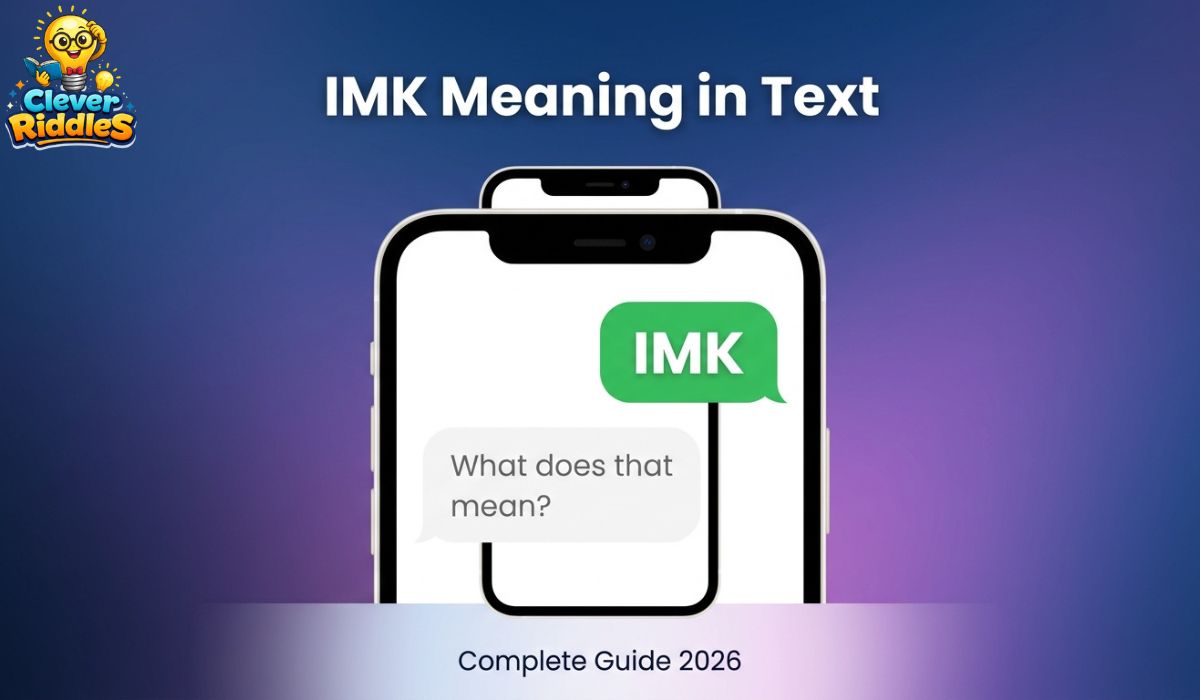
You just received a text message that says “IMK.” You have no idea what it means. Your brain starts spinning. Is it good? Is it bad? Is it something you should know? Should you respond or ignore it?
Relax. You’re not alone. Thousands of people search for IMK meaning every single month. They’re confused. They’re anxious. They don’t want to look stupid by replying wrong.
This complete guide answers every question you have about IMK. You’ll learn exactly what it means. You’ll understand when to use it and when to avoid it. You’ll discover the difference between IMK and similar abbreviations like IMO, LMK, and IDK. You’ll even get real conversation examples and proven reply strategies.
By the end of this article, you’ll never second guess IMK again. You’ll know exactly what it means. You’ll know exactly how to respond. And you’ll communicate with confidence in any digital conversation.
Let’s get started.
What Does IMK Mean in Texting?
IMK stands for “In My Knowledge.” It’s a shorthand people use when they want to share information but leave room for being wrong. Think of it as a verbal disclaimer wrapped in four letters.
When someone types IMK, they’re saying “I believe this is true based on what I know right now, but I’m not claiming absolute certainty.” It’s the digital equivalent of shrugging while making a point.
You’ll see IMK pop up in text messages, Instagram comments, TikTok captions, and group chats. It’s casual, quick, and incredibly useful for everyday digital conversations.
The Direct Definition of IMK
IMK means “In My Knowledge.” It signals that the sender is sharing information they believe to be accurate but acknowledges they could be mistaken. It’s a humility marker in digital communication.
Why People Use IMK Instead of Full Words
People use IMK because it saves time. Typing four letters takes half a second. Typing “In My Knowledge” takes four seconds. In fast moving conversations, that difference matters.
Beyond speed, IMK adds nuance. It softens statements. It prevents arguments. It allows people to help without taking responsibility for being wrong.
IMK vs IMO vs LMK vs IDK: What’s the Difference?
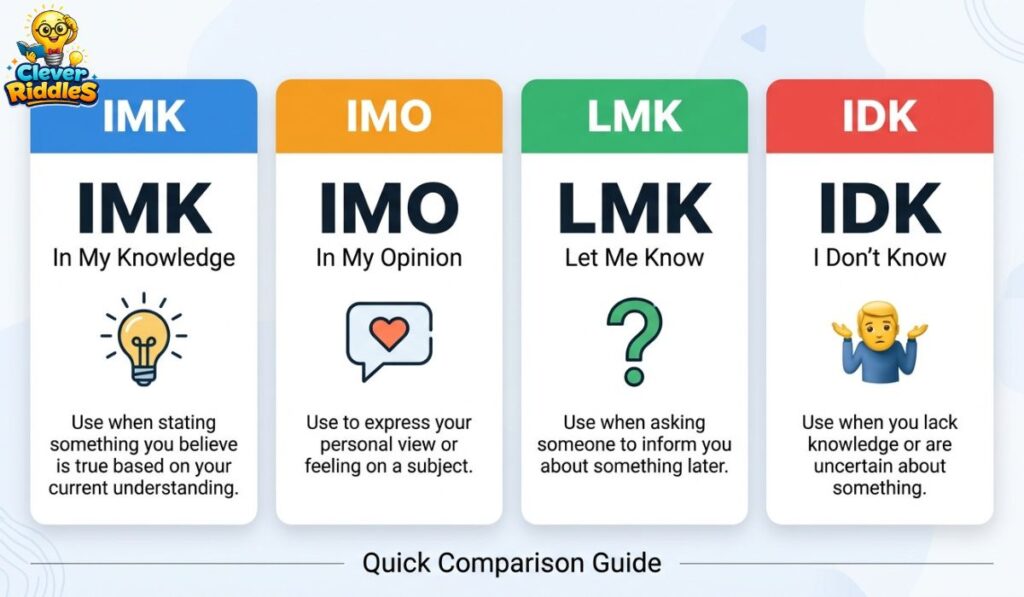
This is where most people mess up. They treat all text abbreviations like they’re interchangeable. They’re not. Each serves a completely different purpose.
IMK vs IMO: Facts vs Opinions
IMO is about feelings and personal preference. IMK is about facts and knowledge. This distinction matters enormously.
IMO: “This pizza is the best in town.” (Subjective. Can’t be proven.)
IMK: “This pizza place closes at 10.” (Factual. Could be verified.)
One is opinion. One is knowledge. Never confuse them.
IMK vs LMK: Giving vs Requesting Information
LMK is a request for information. IMK is a statement of information. They’re opposites in function.
LMK: “Tell me when you’re free.”
IMK: “I think you’re free at 3.”
LMK asks. IMK tells. Simple.
IMK vs IDK: Confidence vs Uncertainty
IDK is an admission of ignorance. IMK is a qualified statement of knowledge. The difference is confidence.
IDK: “I have no idea where the party is.”
IMK: “The party might be at Jake’s place.”
IDK admits defeat. IMK offers help with a safety net.
Comparison Table to Add After IMK vs Section:
| Abbreviation | Full Form | Purpose | Confidence Level |
| IMK | In My Knowledge | Share uncertain facts | Medium |
| IMO | In My Opinion | Share personal views | High (subjective) |
| LMK | Let Me Know | Request information | N/A |
| IDK | I Don’t Know | Admit ignorance | High |
| AFAIK | As Far As I Know | Share limited knowledge | Low |
How to Use IMK Correctly in Conversations
Using IMK isn’t complicated. But using it correctly requires judgment. Here’s exactly when and when not to use it.
When You Should Use IMK
Use IMK when you’re reasonably sure about something but haven’t verified it. Use it in casual chats with friends. Use it in group texts when planning events. Use it on social media when commenting on posts.
Good use: “IMK the store opens at 9 on weekends.”
Good use: “IMK she mentioned coming to the party.”
When You Should Never Use IMK
Never use IMK for things you know with certainty. Never use it for facts everyone knows. Never use it when you’re expected to be authoritative.
Bad use: “IMK the earth revolves around the sun.”
Bad use: “IMK 2+2 equals 4.”
One is helpful. One is ridiculous.
Professional vs Casual Use of IMK
Never use IMK in professional emails. Never use it in client communications. Never use it in academic writing. Never use it in formal documents.
“IMK the quarterly report is due Friday” makes you sound unprofessional. “According to my records, the quarterly report is due Friday” makes you sound competent.
Know the difference. It costs you nothing and gains you respect.
Is IMK Rude or Flirty? Understanding the Tone
Here’s the truth. Tone in text is 90% context and 10% words. IMK itself is neutral. What transforms it is everything around it.
How Context Changes the Tone of IMK
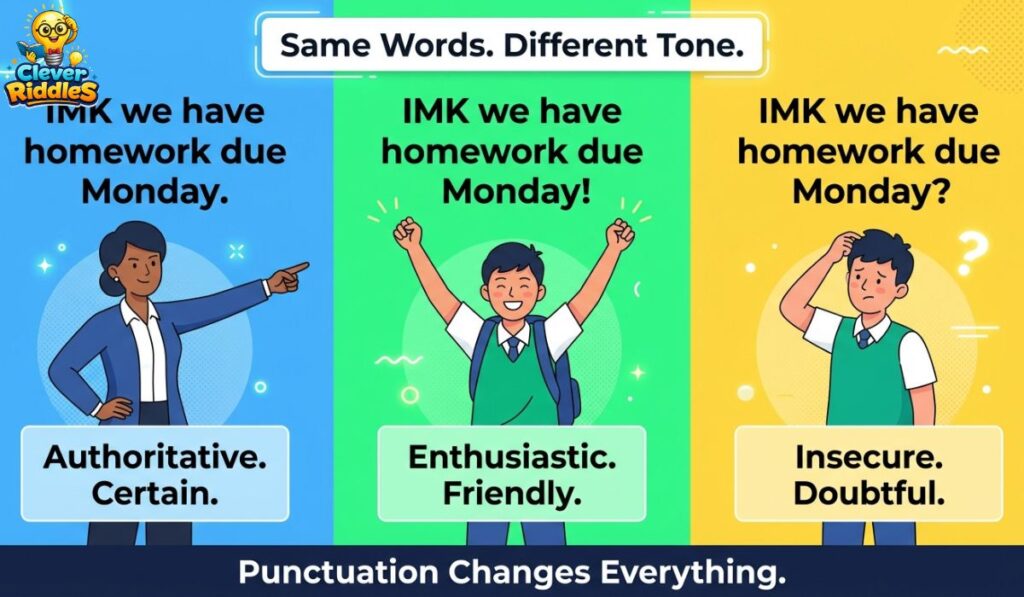
IMK with a period: “IMK we have homework due Monday.” (Authoritative. Certain.)
IMK with an exclamation: “IMK we have homework due Monday!” (Enthusiastic. Friendly.)
IMK with a question mark: “IMK we have homework due Monday?” (Insecure. Doubtful.)
Same letters. Three completely different tones.
Does IMK Mean Something Different From a Girl or Guy?
This is the question everyone actually wants answered. Here’s the uncomfortable truth. IMK doesn’t change meaning based on gender. It changes meaning based on relationship and history.
From a girl you just met: Neutral information sharing.
From a girl you’re dating: Still neutral information sharing.
From a guy you’re interested in: Neutral information sharing.
Stop overanalyzing gender. Start analyzing the relationship. If you’re close with someone, IMK carries warmth. If you’re distant, it carries formality. The letters don’t change. The connection does.
How to Respond When Someone Texts You IMK
This is where most people freeze. They get a message with IMK and don’t know how to reply without sounding awkward. Here’s the playbook.
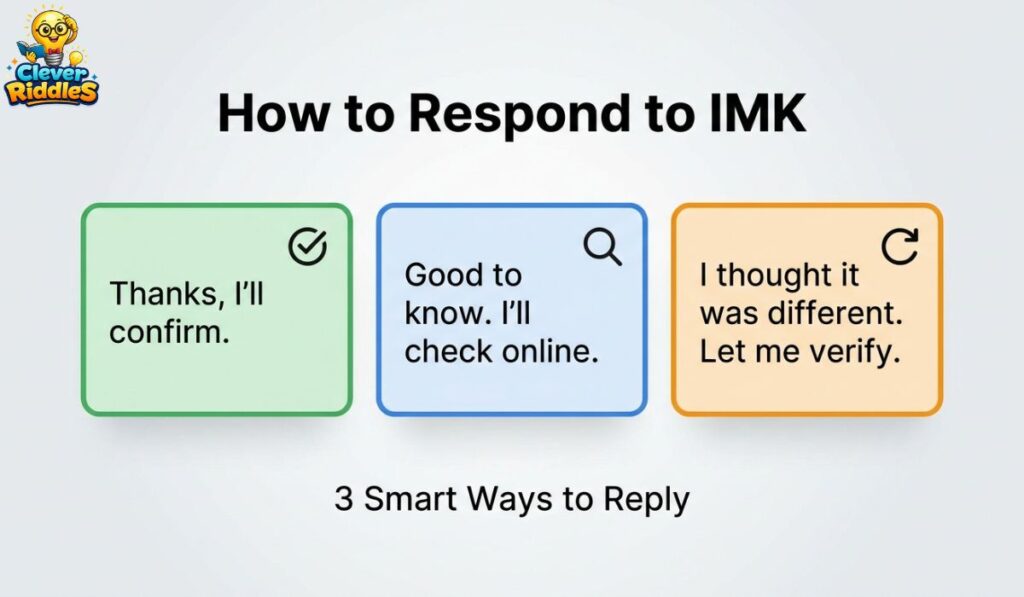
3 Smart Ways to Reply to IMK
Option 1: “Thanks, I’ll confirm.”
Option 2: “Good to know. I’ll check online.”
Option 3: “I thought it was different. Let me verify.”
Every response acknowledges the information while taking responsibility to verify it. You’re not challenging the person. You’re protecting yourself from misinformation.
What Not to Say When Someone Uses IMK
Don’t say “Are you sure?” That questions their knowledge unnecessarily.
Don’t say “I already knew that.” That dismisses their contribution.
Don’t say “IMK isn’t a real word.” That makes you look clueless.
The hidden genius of IMK is simple. It allows the sender to help while allowing the receiver to double check. It’s a system designed to prevent blame.
Real Conversation Examples Using IMK
These aren’t theoretical. These are actual conversations that happen every day.
IMK in Casual Texting
Alex: “What time are we meeting?”
Jordan: “IMK we said 2 pm. But check the group chat.”
IMK in Social Media Comments
Comment: “Are these shoes true to size?”
Reply: “IMK they run small. Size up.”
IMK in Group Chats
Sarah: “Who’s bringing snacks?”
Mike: “IMK Emily volunteered. She mentioned chips and dip.”
IMK in Gaming Conversations
Player 1: “Where’s the hidden chest?”
Player 2: “IMK it’s behind the waterfall. I saw a video.”
Every example shows the same pattern. Sharing knowledge while leaving room for error. Clean. Helpful. Non confrontational.
Most Common Mistakes People Make With IMK
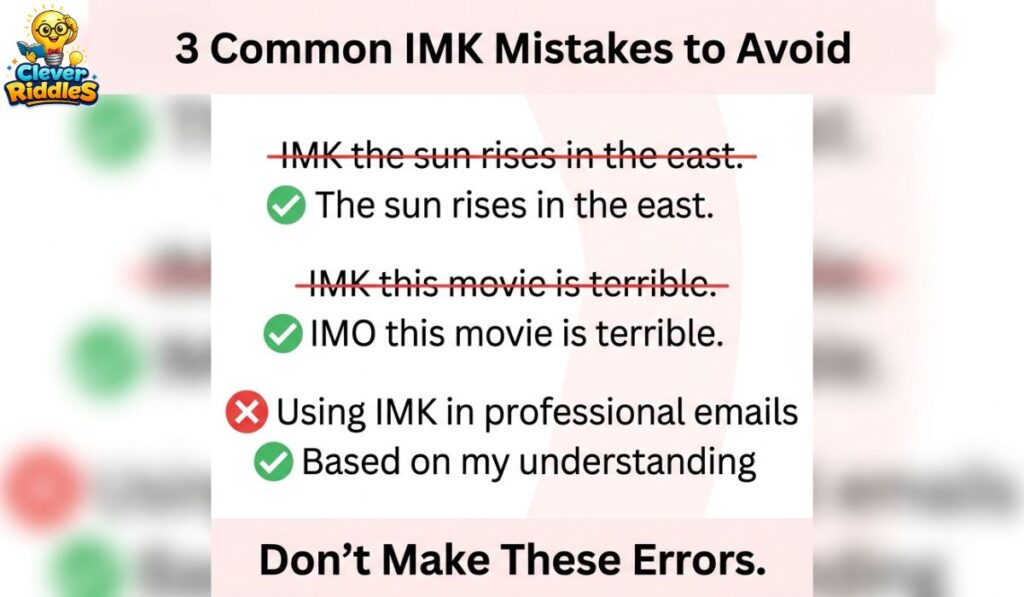
People screw this up constantly. Let’s fix that.
Mistake 1: Using IMK for Absolute Facts
This makes you look uneducated. If you know something with certainty, don’t weaken it with IMK.
Wrong: “IMK the sun rises in the east.”
Right: “The sun rises in the east.”
IMK is for uncertain knowledge. Using it for facts is like using a safety net when you’re standing on solid ground. Unnecessary and odd.
Mistake 2: Confusing IMK With IMO
Feelings are not facts. IMO is for feelings. IMK is for facts you’re unsure about.
Wrong: “IMK this movie is terrible.”
Right: “IMO this movie is terrible.”
One is stating opinion as knowledge. One is stating opinion honestly. Don’t be wrong.
Mistake 3: Using IMK in Formal Writing
Your boss doesn’t want to see IMK. Your professor doesn’t want to see IMK. Your client doesn’t want to see IMK.
Formal writing demands complete words and proper grammar. IMK is for text messages and social media. Keep it there.
Where Is IMK Most Commonly Used?
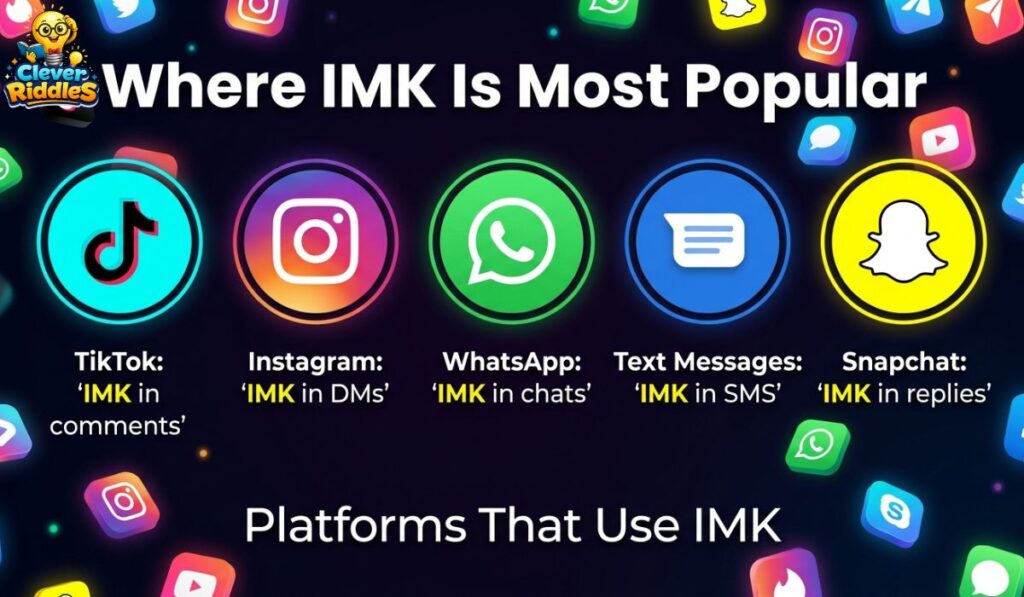
IMK lives where people communicate quickly. That means every major social platform and messaging app.
IMK on TikTok and Instagram
On TikTok, IMK appears in comments and captions. People use it when sharing trivia, giving advice, or correcting misinformation. The platform’s fast paced nature makes abbreviations essential.
On Instagram, IMK shows up in DMs and comment sections. Influencers use it when answering fan questions. Friends use it when planning meetups. It’s everywhere.
IMK in Text Messages and WhatsApp
Text messaging is where IMK thrives. SMS and iMessage are inherently casual. Abbreviations like IMK save time and mental energy. Why write “from what I know” when you can type three letters?
The difference is speed. IMK takes half a second to type. The full phrase takes five. In fast moving conversations, half a second matters.
IMK in Gen Z Digital Culture
Gen Z adopted IMK because it fits their communication style. Fast. Efficient. Flexible. It allows them to share information without appearing arrogant. It’s the perfect millennial and Gen Z compromise.
Why did it gain popularity? Simplicity. IMK does one thing well. It signals knowledge with humility. In a world of online arguments and certainty addiction, IMK offers a refreshing middle ground.
Frequently Asked Questions About IMK
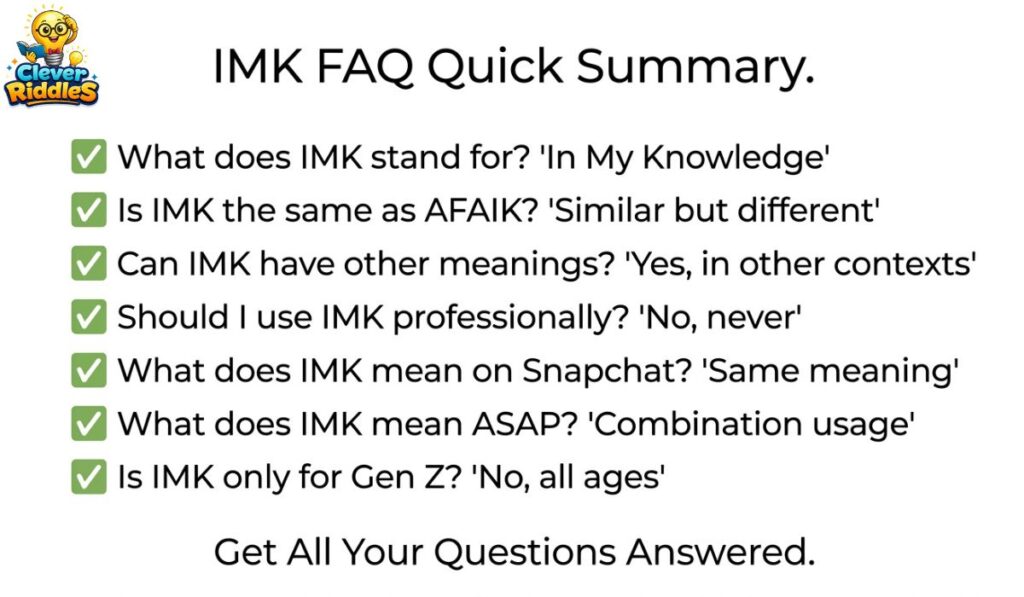
What does IMK stand for exactly?
IMK stands for “In My Knowledge.”
Is IMK the same as AFAIK?
They are similar but not identical. AFAIK means “As Far As I Know.” IMK means “In My Knowledge.” AFAIK implies you’re saying what you know within the boundaries of your experience. IMK is slightly more confident. Both acknowledge potential error.
Can IMK have other meanings?
IMK can stand for other things in different contexts. It might mean “I Must Know” in some circles. It could reference “Imphal Airport” in India. But in texting and social media, IMK means “In My Knowledge” 99% of the time.
Should I use IMK in professional emails?
No. Never. Professional communication demands clarity and professionalism. Write “Based on my understanding” or “According to my records” instead.
What does IMK mean on Snapchat?
On Snapchat, IMK means exactly what it means everywhere else. “In My Knowledge.” Snapchat users love abbreviations because they save time and screen space.
What does IMK mean in ASAP context?
When combined with ASAP, IMK means “In My Knowledge As Soon As Possible.” This is a rare combination but can appear in workplace chats. Example: “IMK ASAP we need those numbers.”
Is IMK only used by Gen Z?
No. Gen Z popularized IMK, but the abbreviation predates them. Millennials used it in early 2000s chat rooms. Gen Z simply accelerated its adoption across social platforms.
Final Thoughts: Why Understanding IMK Matters
IMK is more than just three letters. It’s a communication tool that solves a real problem. How do you share knowledge without overpromising? How do you help someone without taking responsibility for their actions?
IMK answers both questions elegantly. It allows you to contribute to a conversation while protecting yourself from being wrong. It’s a humble abbreviation that fosters better digital communication.
Understanding IMK matters because digital communication isn’t going anywhere. Every day, billions of text messages and social media posts use abbreviations. Knowing what they mean and how to use them makes you a better communicator. It saves time. Reduces confusion. Prevents arguments.
The next time you see IMK in a text, you’ll know exactly what it means. And more importantly, you’ll know exactly how to respond. That’s the real value. Not just decoding the letters. But navigating the conversation with confidence and clarity.
Now stop overthinking and start using IMK correctly. Your friends will appreciate it. Your professional contacts won’t see it. And you’ll communicate better than 90% of people online.

Emilia is a passionate content writer and meaning explorer at Cleverriddles.com, dedicated to helping readers understand words, phrases, and concepts in the simplest way possible. With a strong interest in language, SEO, and digital trends, she creates easy-to-read, informative content that adds real value to users.