Science is full of big, fascinating words, and the letter N brings some real gems to the table. From physics concepts that explain how our universe works, to chemistry terms that describe the building blocks of matter, N has it all. Even space science throws in a few mind-bending words that start with this letter.
If you’ve ever come across a term like “neutron” or “nebula” and wondered what it actually means, you’re not alone. Science vocabulary can feel intimidating, but it doesn’t have to be. This list breaks down each word into simple, everyday language anyone can understand.
Whether you’re studying for a test, brushing up on general knowledge, or just love learning random cool facts, this guide is for you. We’ve handpicked the most interesting and useful science words starting with N. Let’s explore them together, one term at a time.
Why Do Science Words Starting With N Matter?
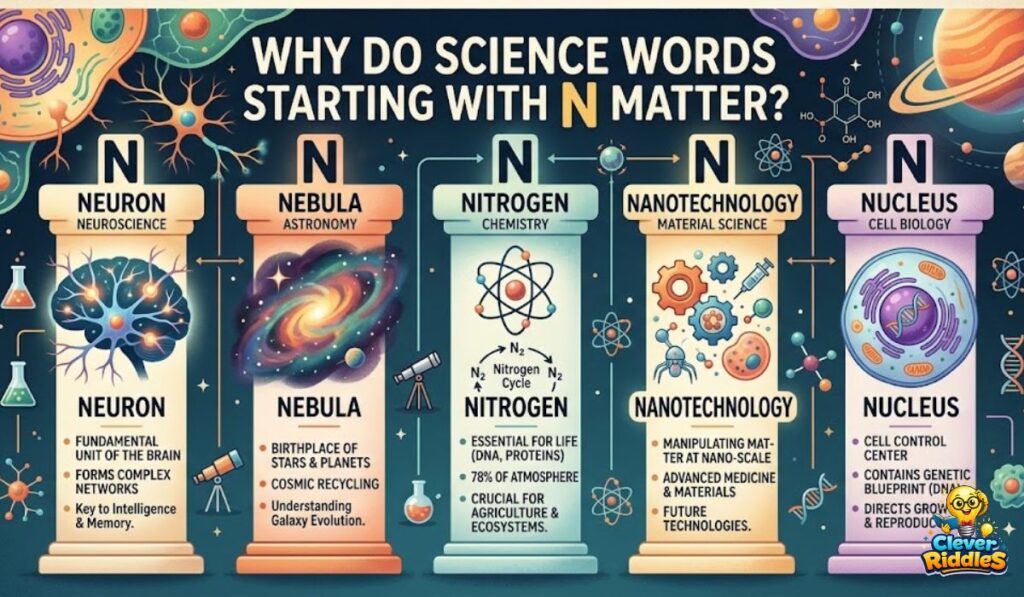
Learning science vocabulary isn’t just about memorizing terms for a test it actually helps you make sense of the world around you. Words like “neutron,” “nucleus,” or “nebula” show up everywhere, from news articles to documentaries to everyday conversations about space and technology. Once you understand these words, science suddenly feels a lot less confusing and a lot more interesting.
Words starting with N also cover some pretty essential science concepts. Think about it you can’t really talk about atoms without mentioning the “nucleus,” or explore space without running into “nebula” and “neutron star.” These aren’t random words; they’re key building blocks that connect to bigger ideas in physics, chemistry, and astronomy.
Plus, knowing these terms gives you a real confidence boost. Whether you’re helping a kid with homework, chatting about a space documentary, or just want to sound smart at trivia night, having these N-words in your vocabulary makes a real difference.
Physics Science Words That Start With N
| Word | Subject | Meaning |
| Neutron | Physics | Neutral particle in an atom’s nucleus |
| Newton | Physics | SI unit used to measure force |
| Nuclear fission | Physics | Splitting of a heavy atomic nucleus, releasing energy |
| Nuclear fusion | Physics | Combining light nuclei into a heavier one, releasing energy |
| Node | Physics | Point on a wave with zero displacement |
| Nanotechnology | Physics | Science of manipulating matter at an atomic scale |
| Neutrino | Physics | Tiny, nearly massless particle that rarely interacts with matter |
| Newtonian mechanics | Physics | Physics based on Newton’s laws of motion and gravity |
| Normal force | Physics | Support force exerted by a surface on an object |
| Net force | Physics | Total combined force acting on an object |
| Natural frequency | Physics | Frequency an object vibrates at without outside force |
| Nuclear reactor | Physics | Device that controls nuclear fission for energy |
| Null point | Physics | Location where net field strength or force is zero |
Chemistry Science Words That Start With N
| Word | Subject | Meaning |
| Nitrogen | Chemistry | Colorless gas making up 78% of Earth’s atmosphere |
| Neon | Chemistry | Noble gas used in glowing signs |
| Nickel | Chemistry | Silvery-white metal used in alloys and batteries |
| Nucleus | Chemistry | Dense central core of an atom |
| Neutralization | Chemistry | Reaction where an acid and base form water and salt |
| Nonmetal | Chemistry | Element lacking metallic properties |
| Noble gas | Chemistry | Group of unreactive gases like helium and neon |
| Nitrate | Chemistry | Nitrogen-oxygen compound found in fertilizers |
| Nitric acid | Chemistry | Corrosive acid used in fertilizers and explosives |
| Nylon | Chemistry | Synthetic polymer fiber used in textiles |
| Normality | Chemistry | Measure of solution concentration |
| Nucleophile | Chemistry | Species that donates electrons to form a bond |
| Naphthalene | Chemistry | White crystalline compound used in mothballs |
Biology Science Words That Start With N
| Word | Subject | Meaning |
| Nucleus | Biology | Control center of a cell holding genetic material |
| Neuron | Biology | Nerve cell |
| Nutrient | Biology | Substance providing nourishment for growth |
| Natural selection | Biology | Survival and reproduction of better-adapted organisms |
| Nematode | Biology | Type of roundworm |
| Niche | Biology | Role a species occupies in its ecosystem |
| Nucleic acid | Biology | Biomolecule like DNA or RNA carrying genetic info |
| Nectar | Biology | Sugary liquid produced by flowers |
| Nocturnal | Biology | Active mainly at night |
| Notochord | Biology | Flexible rod in embryos that helps form the spine |
| Node (lymph) | Biology | Small tissue mass involved in the immune system |
| Nucleotide | Biology | Basic building block of DNA and RNA |
| Nervous system | Biology | Network of nerves carrying signals through the body |
Astronomy & Space Science With N
| Word | Subject | Meaning |
| Nebula | Astronomy | Cloud of gas and dust in space |
| Neutron star | Astronomy | Extremely dense core left after a supernova |
| Nova | Astronomy | Sudden brightening of a star from a surface explosion |
| Neptune | Astronomy | Eighth and farthest known planet from the sun |
| North Star | Astronomy | Polaris, used historically for navigation |
| Near-Earth object | Astronomy | Asteroid or comet with an orbit close to Earth |
| Nucleus (comet) | Astronomy | Solid, icy core at a comet’s center |
| Novae | Astronomy | Plural of nova |
| Night sky | Astronomy | View of stars and planets visible after dark |
| NASA | Astronomy | U.S. space agency for exploration and research |
| Nadir | Astronomy | Point directly below an observer, opposite the zenith |
| Nanosatellite | Astronomy | Miniature satellite for research or low-cost missions |
| New Moon | Astronomy | Lunar phase when the moon isn’t visible from Earth |
Earth & Environmental Science Words Starting With N
| Word | Subject | Meaning |
| Nitrogen cycle | Environmental Science | Movement of nitrogen between air, soil, and organisms |
| Natural resource | Environmental Science | Material from nature used by humans |
| National park | Environmental Science | Protected land for conservation and public use |
| Nonrenewable energy | Environmental Science | Energy sources that can’t be replaced once used |
| Nimbus | Environmental Science | Cloud type associated with rain or storms |
| Nutrient cycle | Environmental Science | Movement of nutrients through an ecosystem |
| Natural disaster | Environmental Science | Sudden environmental event causing major damage |
| Niche (ecological) | Environmental Science | Environmental role a species needs to survive |
| Nitrogen fixation | Environmental Science | Converting atmospheric nitrogen into usable form |
| Nature reserve | Environmental Science | Protected area for wildlife and habitats |
| Noise pollution | Environmental Science | Harmful excess sound from human activity |
| Non-point source pollution | Environmental Science | Pollution from multiple diffuse sources |
| Net primary productivity | Environmental Science | Rate of energy plants produce minus their own use |
Medical & Health Science Words That Start With N
| Word | Subject | Meaning |
| Nutrition | Medical Science | Process of consuming food for growth and health |
| Neurology | Medical Science | Branch of medicine treating nervous system disorders |
| Nausea | Medical Science | Feeling of sickness with an urge to vomit |
| Neonatal | Medical Science | Relating to newborn babies |
| Nervous breakdown | Medical Science | Intense period of mental or emotional distress |
| Necrosis | Medical Science | Death of body tissue from injury or lack of blood |
| Nasal cavity | Medical Science | Hollow space behind the nose |
| Neurotransmitter | Medical Science | Chemical messenger between nerve cells |
| Nutrient deficiency | Medical Science | Lack of essential vitamins or minerals |
| Node (lymph node) | Medical Science | Immune structure that filters harmful substances |
| Narcolepsy | Medical Science | Sleep disorder causing sudden sleep episodes |
| Neuroplasticity | Medical Science | Brain’s ability to form new neural connections |
| Numbness | Medical Science | Loss of sensation from nerve compression or damage |
Technology & Applied Science Words With N
| Word | Subject | Meaning |
| Nanotechnology | Technology | Engineering matter at the atomic scale |
| Network | Technology | System of interconnected devices sharing data |
| Node (computing) | Technology | Connection point in a network or data structure |
| Neural network | Technology | AI computing system modeled on the brain |
| Nuclear power | Technology | Electricity generated from nuclear fission |
| Navigation system | Technology | Tech used to determine location and direction |
| NFC | Technology | Short-range wireless tech for contactless payments |
| Notebook (computer) | Technology | Portable personal computer, or laptop |
| NAS | Technology | Network-connected device for shared file storage |
| Numerical control | Technology | Automated control of machining tools via programming |
| Nanobot | Technology | Microscopic robot operating at the nanoscale |
| Non-volatile memory | Technology | Memory that retains data without power |
| Node.js | Technology | Runtime environment for running JavaScript outside a browser |
Easy Science Words That Start With N
| Word | Subject | Meaning |
| Nature | General Science | The physical world not made by humans |
| Night | General Science | Period of darkness between sunset and sunrise |
| Nest | General Science | Structure animals build to lay eggs or raise young |
| Nail | General Science | Hard covering at the tips of fingers and toes |
| Noise | General Science | Any sound, especially loud or unwanted |
| Net | General Science | Mesh material used for catching or holding things |
| Nutrient | General Science | Substance in food that helps the body grow |
| North | General Science | One of the four main compass directions |
| Neon | General Science | Glowing gas used in colorful signs |
| Newt | General Science | Small amphibian similar to a salamander |
| Nut | General Science | Hard-shelled seed or fruit |
| Needle | General Science | Thin, pointed tool for sewing or injections |
| Nose | General Science | Body part used for breathing and smelling |
Advanced & Technical Science Words With N
| Word | Subject | Meaning |
| Neutrino oscillation | Physics | Neutrinos changing type as they travel |
| Nucleosynthesis | Astrophysics | Creation of new atomic nuclei, often inside stars |
| Nanophotonics | Physics | Study of light behavior at the nanometer scale |
| Non-Euclidean geometry | Mathematics | Geometry that doesn’t follow flat-plane rules |
| Nucleophilic substitution | Chemistry | Reaction where a nucleophile replaces a molecular group |
| Newtonian fluid | Physics | Fluid with constant viscosity regardless of force |
| Nyquist theorem | Engineering | Principle determining minimum signal sampling rate |
| Neural plasticity | Neuroscience | Brain’s capacity to adapt and rewire itself |
| Non-linear dynamics | Mathematics | Study of systems with disproportionate input-output behavior |
| Nucleotide sequencing | Genetics | Determining the exact order of nucleotides in DNA/RNA |
| Nanoscale engineering | Engineering | Designing structures at the scale of atoms |
| Null hypothesis | Statistics | Default assumption of no effect or relationship |
| Noether’s theorem | Physics | Principle linking symmetries in nature to conservation laws |
Common Science Words Beginning With N
| Word | Subject | Meaning |
| Nucleus | Biology/Chemistry | Central core of a cell or atom |
| Neutron | Physics | Neutral particle inside an atom’s nucleus |
| Nitrogen | Chemistry | Key element making up most of Earth’s air |
| Nebula | Astronomy | Cloud of gas and dust in space |
| Neuron | Biology | Nerve cell that transmits signals |
| Nanotechnology | Technology | Science of the extremely small |
| Newton | Physics | Standard unit of force |
| Nocturnal | Biology | Active during the night |
| Nutrient | General Science | Substance that nourishes living things |
| Nova | Astronomy | Sudden burst of brightness from a star |
| Node | Physics/Tech | Fixed or connecting point in a system |
| Nonmetal | Chemistry | Element without metallic properties |
| Natural selection | Biology | Survival of the best-adapted organisms |
Lesser-Known Science Words That Begin With N
| Word | Subject | Meaning |
| Neutrino | Physics | Almost massless particle that barely interacts with matter |
| Nickel | Chemistry | Metal used in coins, batteries, and alloys |
| Neon | Chemistry | Noble gas known for glowing signage |
| Neptune | Astronomy | Farthest known planet in our solar system |
| Nematode | Biology | Microscopic worm found in soil and water |
| Nitrate | Chemistry | Nitrogen-based compound used in fertilizers |
| Nuclear fusion | Physics | Energy-producing process that powers stars |
| Niche | Biology | Organism’s specific role in its ecosystem |
| Notochord | Biology | Early embryonic structure that helps form the spine |
| North Star | Astronomy | Star used historically for navigation |
| Nasal cavity | Medical Science | Internal passage behind the nose |
| Network | Technology | Connected system of devices or contacts |
| Nucleotide | Biology/Genetics | Basic unit that makes up DNA and RNA |
Fun Facts About Science Words That Start With N
- Neutron stars are so dense that just one teaspoon of their material would weigh about a billion tons on Earth.
- The word “nebula” comes from the Latin word for “cloud” or “mist,” which makes sense since nebulae look like glowing clouds in space.
- The newton, the unit of force, was named after Sir Isaac Newton by later scientists he never used the term himself.
- Nitrogen makes up about 78% of the air we breathe, even though oxygen usually gets more attention.
- Neurons in the human brain can send signals at speeds of up to 268 miles per hour, faster than a Formula 1 race car.
- Noble gases like neon and argon got their name because they rarely react with other elements, almost as if they’re too “noble” to mix.
- A nanosecond is one billionth of a second light itself only travels about one foot in that time.
- Nocturnal animals have evolved eyes with more rod cells, helping them see far better in the dark than humans.
- The nucleus of an atom is incredibly tiny, yet it holds almost all of the atom’s mass, similar to a marble inside a football stadium.
- Nylon was the first fully synthetic fiber ever created, invented in 1935, and it changed the fashion and textile industry forever.
- A single bolt of lightning can briefly reach temperatures hotter than the surface of the sun, and nitrogen in the air helps produce its blue-white flash.
- Neptune’s strong winds are the fastest in the solar system, reaching speeds of over 1,200 miles per hour.
FAQs
What are science terms that start with N?
Science terms starting with N include neutron, nucleus, nebula, nitrogen, and neuron, spanning physics, chemistry, biology, and astronomy.
What is a chemistry term that starts with N?
Nitrogen is a common chemistry term that starts with N, referring to a nonmetal element essential for life.
What are 10 science terms?
Ten common science terms are neutron, nucleus, nitrogen, neuron, nebula, newton, nickel, neon, nutrient, and node.
What stands for N in science?
In science, N commonly stands for nitrogen on the periodic table, though it can also represent newton (force) or normal (concentration) depending on context.
What is the N in physics?
In physics, N typically represents newton, the SI unit used to measure force.
Conclusion
Science words that start with N cover an impressive range of topics from tiny neutrons and nuclei to massive nebulae floating in space. Whether you’re diving into physics, chemistry, biology, or astronomy, this letter offers some truly fascinating vocabulary worth knowing.
Hopefully, this list has made these terms feel a little less intimidating and a lot more interesting. The next time you come across a word like “neuron” or “nova,” you’ll know exactly what it means and why it matters.
Keep exploring, keep asking questions, and remember science is everywhere, even hiding in the words we use every day.

Emilia is a passionate content writer and meaning explorer at Cleverriddles.com, dedicated to helping readers understand words, phrases, and concepts in the simplest way possible. With a strong interest in language, SEO, and digital trends, she creates easy-to-read, informative content that adds real value to users.